Serengeti Balloon Rides with Kids: Age Rules, Weight Rules and Whether to Bring Them
Two operators, two different age minimums, and no child discount anywhere in the lineup. Here is what a family actually has to plan around.
 By Juma Kimaro, Serengeti balloon safari specialist since 2015
Short answer
The linked SBS Viator flight starts at seven, even though SBS’s own FAQ says six. Miracle’s listing uses child bands from five but excludes under 120 cm; confirm acceptance before paying. The SBS Viator flight uses an age-seven-plus adult band; other listings have different child bands and quotes. Pregnancy rules out flying entirely. Serengeti park entry is separate and paid with your safari.
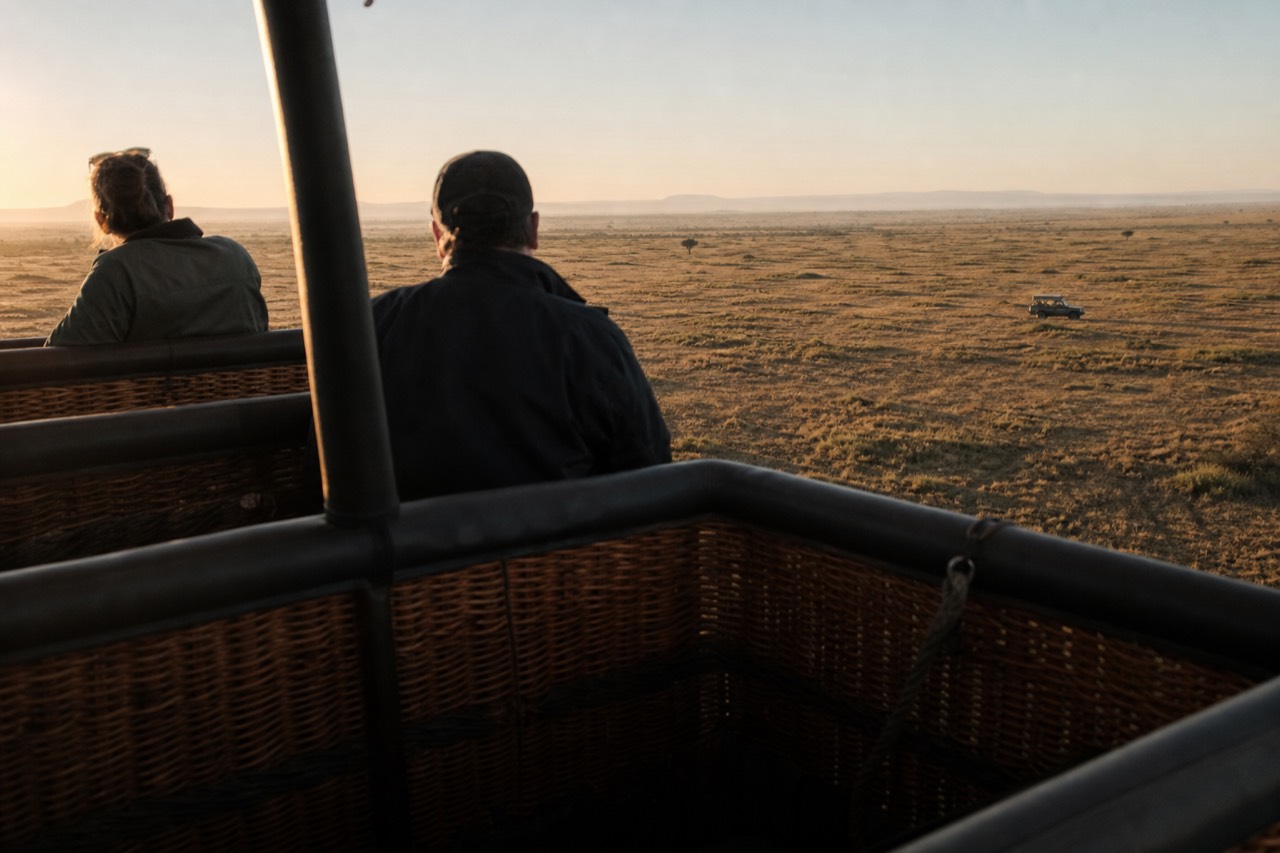
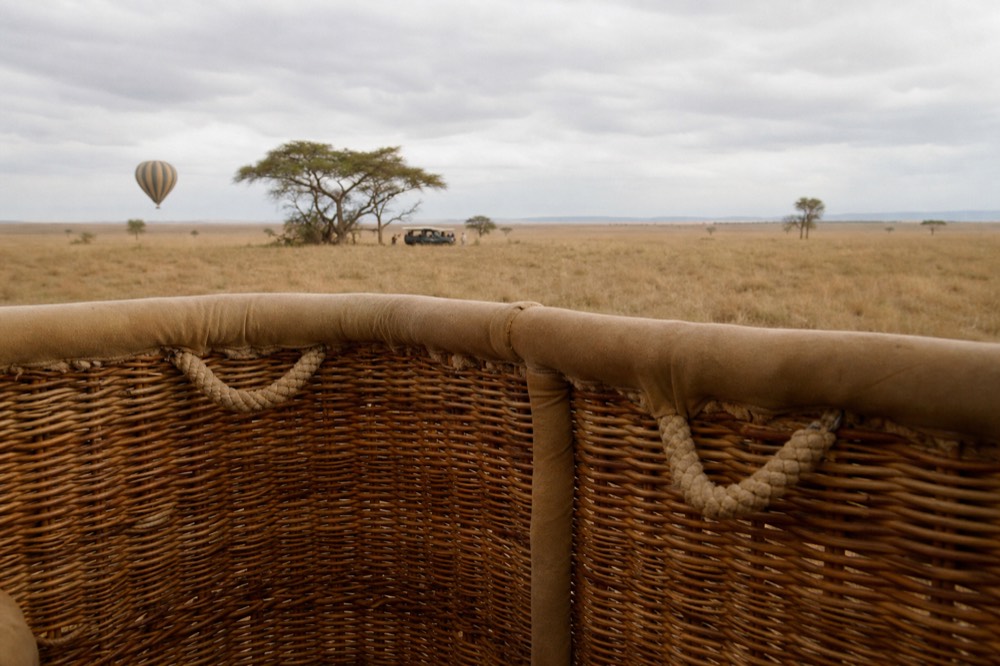
The wicker wall of a balloon basket comes up to roughly chest height on a grown adult. Stand a nine-year-old next to it and the geometry stops being abstract. That single measurement, more than insurance policy or liability language, is what sets the age line on every balloon flight over the Serengeti, and it is why the answer to "can my child come" is a number rather than a judgement call about maturity.
The numbers are not the same across operators, which trips families up constantly.
Start with the youngest traveler’s age and height, then check the terms attached to the exact booking.
Booking choice: SBS’s linked Viator product starts at age seven; compare the other listed requirements before planning a family flight. Explore the itinerary & inclusions
How old does a child have to be to fly over the Serengeti?
It depends on which operator holds your booking. Serengeti Balloon Safaris publishes six in its own FAQ, but its linked Viator booking requires seven. Miracle Experience sets it at seven, with their published terms allowing five to seven only when accompanied by a responsible adult. There is no single Serengeti-wide age rule, so check the listing that carries your booking.
This is the most common family planning error on the whole subject. Parents read one operator's FAQ, find a number, and book a different operator's flight assuming the rule travels. It does not. A six-year-old should not be booked onto the SBS Viator listing based on the operator’s different direct-booking age rule.
| Operator | Published minimum age | Accompanied exception | Rating | Reviews | From |
|---|---|---|---|---|---|
| Serengeti Balloon Safaris | 7 on linked Viator product; direct FAQ says 6 | Confirm the terms for your booking | 4.9 | 3,504 | $599 |
| Miracle Experience | Child band starts at 5 on linked Viator product | Minimum height 120 cm; confirm acceptance | 5.0 | 2,651 | $599 |
| Nyssa Tourism Holdings | Confirm on the booking page | Confirm on the booking page | 4.9 | 8 | $599 |
| Beach & Safari Holidays | Confirm on the booking page | Confirm on the booking page | 5.0 | 3 | $643 |
The two newer listings do not publish an age policy as prominently as the two established operators, so treat their line as unconfirmed and ask before you pay. Both major operators state theirs in writing: the Serengeti Balloon Safaris FAQ and the Miracle Experience FAQ are the primary sources, and neither has moved its number recently.
One practical consequence: a six-year-old needs the exact booking channel’s acceptance confirmed first. Book the flight whose age rule your youngest passenger clears, then work backwards to whether its pickup network reaches your camp.
Do children pay less than adults?
No. Every bookable Serengeti balloon flight charges children the full adult rate, $599 on three listings and $643 on the champagne-breakfast version. No child discount, family rate or under-12 tier appeared anywhere in 2026 pricing. A family of four with two eligible children pays $2,396 for the morning.
Balloon pricing works on lift and basket space rather than on body size. A child occupies one of a finite number of standing positions in a compartment and counts as one passenger against the pilot's weight and volume calculation. There is no half-seat to sell them.
That makes the arithmetic blunt, and it deserves to be looked at squarely before anyone promises a nine-year-old a balloon ride.
| Party | Flight cost at $599 each | Champagne version at $643 each | Park entry, separate |
|---|---|---|---|
| Two adults | $1,198 | $1,286 | Roughly $70 plus 18% VAT per adult per day |
| Two adults, one child aged 8 | $1,797 | $1,929 | Adult rate twice, plus the published child rate |
| Two adults, two children aged 8 and 11 | $2,396 | $2,572 | Adult rate twice, plus two child rates |
| Two adults, one child aged 5 | $1,198 for the adults | $1,286 for the adults | Child stays with a guide, no flight cost |
Park fees are the other half of the family sum and they are not in the ticket. Under the latest published TANAPA tariff a non-East-African adult pays roughly $70 plus 18% VAT per day in the park, with a considerably lower child rate in the five-to-fifteen bracket. Those are charged through your safari operator, not by the balloon company, and they apply whether anyone flies or not. The published tariff document is the primary source, though your safari operator will normally have already folded the figure into your quote. The full picture of what sits inside and outside the ticket is in the complete cost breakdown.
Why does the age minimum exist at all?
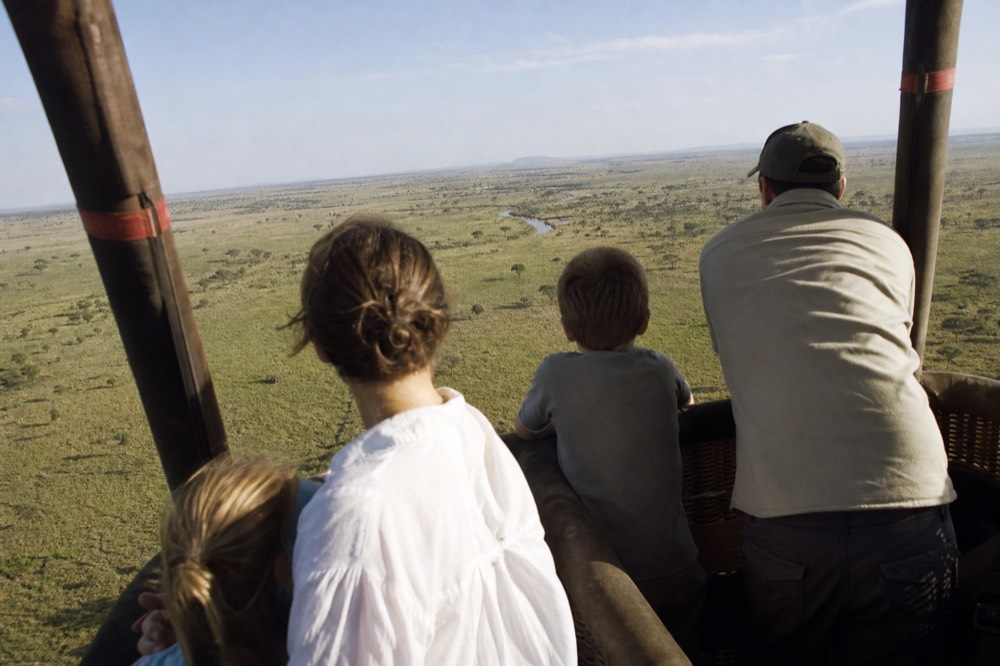
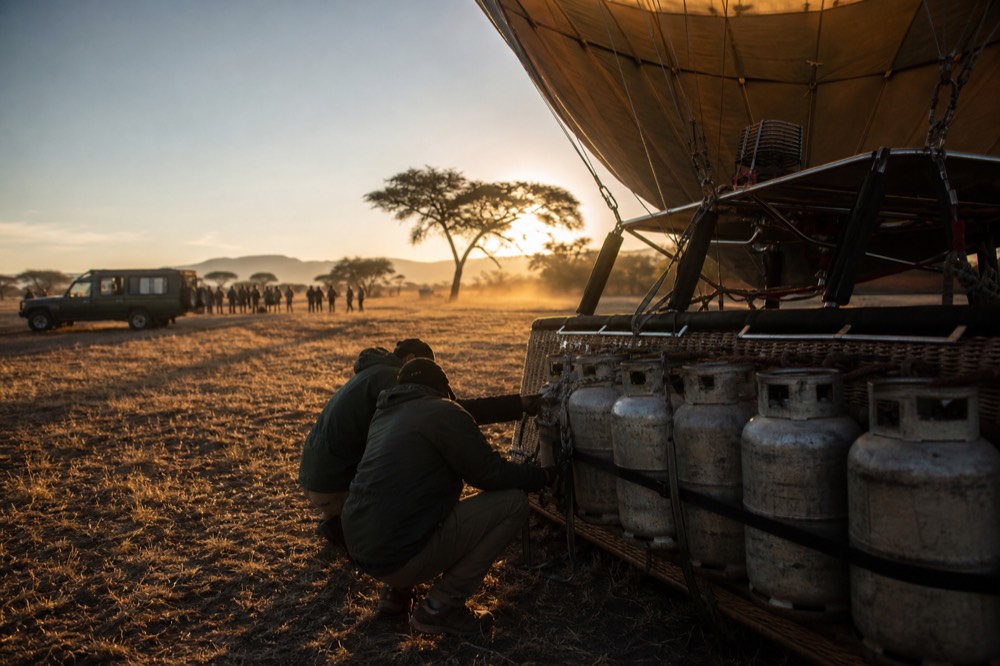
Three physical facts drive it. The basket wall sits at roughly adult chest height, so a small child cannot see out and can climb. There are no seats or restraints, so passengers stand for 50 to 70 minutes. Landings can drag or tip the basket across grass, and everyone aboard must hold a braced position on command.
None of that is dramatic. Balloon flying is calm for almost its entire duration. But the landing is the part where the rules stop being negotiable, and it is worth understanding what the pilot is actually asking of every person in the basket.
On touchdown the basket meets the ground with forward momentum. Depending on surface wind it may skid several metres, and it can go over onto its side. Pilots brief this openly before launch and the brace position is simple: face away from the direction of travel, knees bent, both hands gripping the rope handles inside the wall, no arms or legs outside. A seven-year-old can hold that. A four-year-old, startled and half a metre shorter than the wall, cannot be relied on to.
| Requirement in the basket | What it demands | Why a young child struggles |
|---|---|---|
| Standing unaided, 50-70 minutes | No seats, no restraints, no floor to sit on | Tires quickly, sits down out of sight of the pilot |
| Climbing in over a chest-high wall | Step up and swing a leg across | Needs lifting, which changes the loading |
| Holding the brace position on command | React within seconds to the pilot's call | Reaction to a sudden instruction is unreliable |
| Staying inside the basket during drag | Absolute rule, no exceptions | The instinct to put a hand out is exactly wrong |
| Tolerating a 4:30-6:00am start | Roughly five hours door to door | Overtired children make the whole basket harder |
The last row is not a safety rule but it decides more family mornings than the others combined. Pickup runs from about 4:30 to 6:00am depending on how far your camp sits from the launch site, and the flight is finished by mid-morning. A child who copes badly with a broken night will spend the most expensive hour of your trip wanting to go back to bed.
The SBS Viator listing requires age seven and a suitable camp pickup; its operator-direct FAQ’s age-six rule does not override the marketplace booking terms.
What are the weight rules, and will anyone be weighed?
Operators plan the basket on an 80 kg average per passenger. SBS may charge passengers over 120 kg for a second place; Miracle’s linked Viator listing excludes them. Children obviously sit far under those thresholds, but they still count as a full passenger in the pilot's load calculation, which is the reason they pay full price.
Being weighed at check-in is not universal, and where it happens it is quick and low-key rather than a public exercise. Operators normally take declared weights at booking and confirm them at the launch site. The purpose is not policing; it is that a balloon's lift is finite and the pilot has to know the total mass going into the air alongside the fuel load and the morning's temperature.
Warm air holds less lift than cold, which is one more reason these flights only run at dawn. Load and temperature interact, and a basket planned on accurate numbers flies with margin. This is covered in more detail in the article on whether they weigh you before a balloon ride.
| Passenger | Counts as | Weight consideration | Price paid |
|---|---|---|---|
| Adult under 120 kg | One passenger | Within the standard planning envelope | Full rate |
| Adult over 120 kg / 265 lb | Confirm acceptance first | SBS may require two spaces; Miracle Viator excludes | Operator-dependent |
| Child aged 6 or 7 | One passenger | Well under the planning average of 80 kg | Full adult rate |
| Teenager | One passenger | Treated as an adult in every respect | Full adult rate |
| Infant or toddler | Not carried | Below every operator's minimum age | Cannot fly |
Who in the family cannot fly at all?
Pregnancy is an outright exclusion with both major operators, at any stage. Serious heart conditions, brittle-bone conditions, significant neck or back problems and limited mobility are also restricted, because of the brace position and the possibility of a dragging landing. Children under the operator's stated minimum cannot fly under any circumstances.
Families discover the pregnancy rule late more often than any other restriction, sometimes at the launch site. It is not a soft recommendation and there is no doctor's note that overrides it. The reasoning is the landing again: a sudden lateral impact is a risk nobody is willing to underwrite. The pregnancy question is covered in full here, including how it compares with other operators worldwide.
The mobility restrictions are worth reading literally rather than generously. Boarding means stepping up and over a wall at chest height without assistance from the structure. Grandparents who walk comfortably but cannot manage that movement will struggle, and no amount of goodwill from the ground crew changes the geometry.
What does a family balloon morning actually look like?
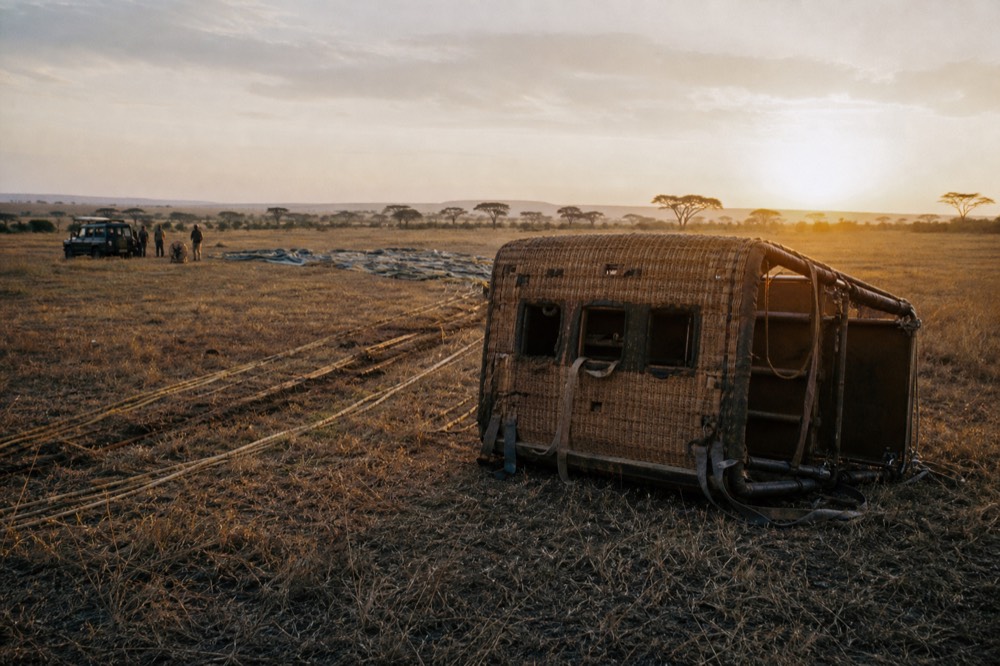
A vehicle collects you between 4:30 and 6:00am depending on camp distance. Tea or coffee at the launch site, a safety briefing, inflation you can watch, boarding at first light, 50 to 70 minutes airborne, then a landing, a sparkling-wine toast for the adults, a cooked bush breakfast and a certificate. Around five hours door to door.
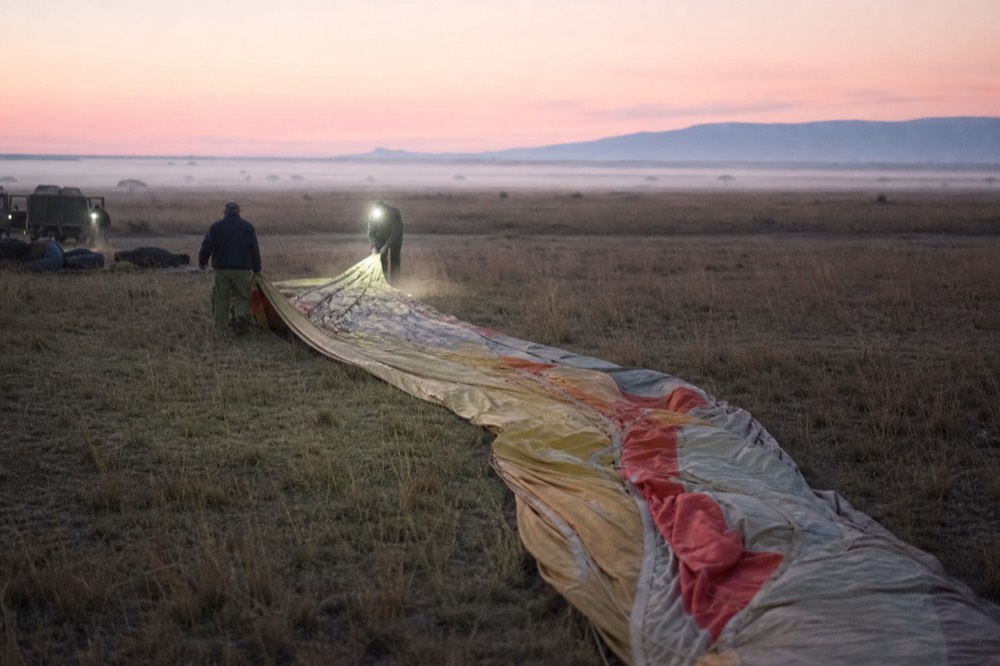
Written as a timeline it looks longer than it feels. The inflation phase is the part children remember: two enormous fans, the envelope filling like a lung, then the burners throwing a column of flame into the mouth of the balloon while the whole thing rises off the grass. It is loud, hot and genuinely thrilling to watch from ten metres away.
| Time | What happens | The child's experience |
|---|---|---|
| 4:30-6:00am | Pickup from camp or lodge, earlier if you are further out | The hardest part of the day, dark and cold |
| Around 5:45am | Arrival, tea and coffee, safety and brace briefing | Attention is fully on the equipment by now |
| Around 6:00am | Cold inflation with fans, then burner inflation | The loudest and most memorable twenty minutes |
| First light | Boarding over the basket wall, liftoff | Needs a lift in, then hands on the rope handles |
| 50-70 minutes | Airborne, burners intermittent, long quiet stretches | Silence surprises them, then boredom is a real risk |
| On landing | Brace, touchdown, possible drag or tip | Brief, over in seconds, always briefed in advance |
| Mid-morning | Toast, full cooked bush breakfast, certificate | The certificate matters more to them than the flight |
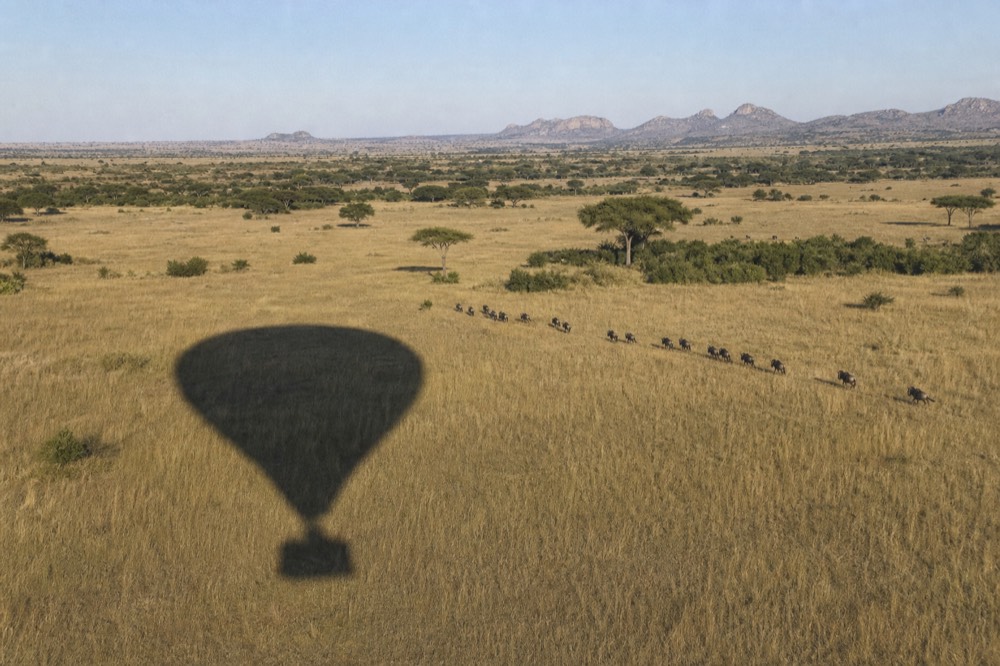
Two practical notes for parents. The quiet stretch in the middle is where younger passengers lose interest, so give them a job: spotting river lines, counting kopjes, watching for the balloon's own shadow crossing the grass. And dress them properly, because the basket at dawn is genuinely cold before the sun clears the horizon, then hot within the hour. The layering guide for a dawn flight applies to children more than adults, since they complain about it sooner.
One thing that is not available on any flight: a toilet. Ground facilities vary: Nyssa lists washrooms at launch and breakfast, but there is no toilet while airborne, and the detail on that is here.
What should an under-six do that morning instead?
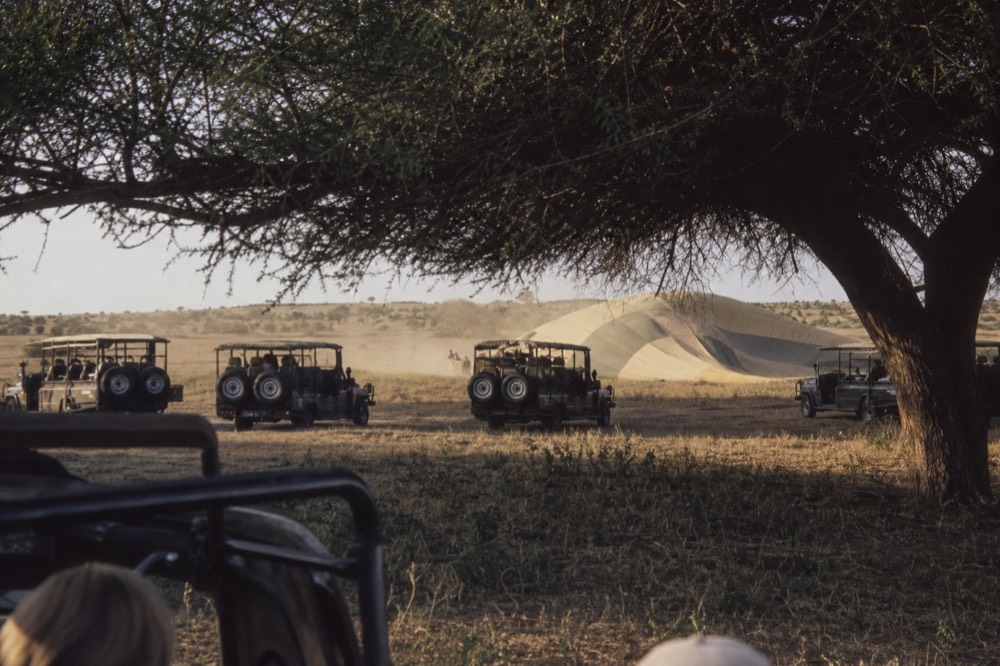
Stay at camp with the non-flying parent and take the standard dawn game drive. It leaves at roughly the same hour, costs nothing extra if your safari already includes it, and reliably produces closer wildlife sightings than a balloon does. Most camps will also arrange supervision if both parents want to fly.
This is a better outcome than families expect. Dawn is the strongest game-viewing window of the day, predators are still active, and a vehicle can sit at fifteen metres from a lion pride while the balloon passes overhead at two hundred. The five-year-old who could not board frequently comes back with the better animal stories.
Splitting the party works well in practice. One parent flies on the first morning, the other on the second if your itinerary allows, and the child gets two dawn drives. Where a camp only permits one, take turns across your stay.
| Option that morning | Cost | What it delivers | Best for |
|---|---|---|---|
| Dawn game drive with the camp | Usually already in your safari rate | Close sightings, predators still active | Any child under the age minimum |
| Both parents fly, camp supervises | $1,198 for two adults | Uninterrupted flight for the adults | Camps with childcare, older toddlers |
| Parents fly on alternating mornings | $599 each, two mornings | Everyone flies, nobody misses the child | Three nights or more in the park |
| Skip the flight this trip | Nothing | Full family days, budget stays intact | Very young families, short itineraries |
Should you actually bring them?
Eligibility and enthusiasm are different questions. Children aged roughly nine and up tend to get the most out of it, since they can follow what the pilot is doing and hold attention through the quiet middle stretch. Six and seven-year-olds need the exact listing’s eligibility checked and often love the inflation more than the flight itself.
The honest split is between children who will remember the morning and children whose parents will remember paying $599 for it.
| Child's age | Eligible? | Likely reaction | Recommendation |
|---|---|---|---|
| Under 5 | No | Not applicable | Dawn game drive, no exceptions |
| 5 | Only under Miracle Experience's accompanied terms | Overwhelmed by the pre-dawn start | Game drive is the better morning |
| 6 | Yes with Serengeti Balloon Safaris | Loves the inflation, fades in the air | Book only if they handle early starts well |
| 7-8 | Yes with both operators | Engaged throughout, needs a job mid-flight | Good, with expectation-setting |
| 9-12 | Yes | The sweet spot, follows the whole operation | Strongly worth it |
| Teenagers | Yes, at full adult rate | Photograph the entire thing | Worth it, same as any adult |
Nothing here is a substitute for a conversation with your own child about a 4:30am alarm. Ask them at bedtime the night before, not at breakfast the week before.
Families whose children fade fastest at the breakfast stage sometimes do better on the Nyssa flight, which launches from the Seronera area year-round and lays on a longer, more dressed-up sit-down meal after landing at the same $599.
What happens if the flight is cancelled with children in the party?
Weather scrubs are refunded in full or rebooked, and every listing also cancels free up to 24 hours before the start. For families that policy is worth building an itinerary around: book your first available morning rather than your last, so a wind-scrubbed flight has somewhere to move to.
Pilots make the call before dawn, based on surface wind and conditions at launch height. It is not influenced by how many people are booked or how far anyone travelled, and it should not be. Roughly one morning in a stretch of good weather goes this way and the operation is designed to absorb it.
The family-specific angle is emotional rather than financial. A refunded flight is fine for adults and genuinely upsetting for a nine-year-old who has been counting down for a week. Frame it in advance as a weather-dependent plan rather than a promise, and hold a spare morning in reserve if your itinerary can carry one.
If you want to see all four flights and their pickup areas together before committing a family to a specific operator, the full lineup is laid out here with each one's coverage and terms. You can also read what the morning runs like hour by hour and the safety picture in detail before deciding.
Frequently asked questions
What is the minimum age for a hot air balloon ride in the Serengeti?
There is no single figure. SBS’s own FAQ starts at six, but the linked Viator product starts at seven. Miracle Experience sets seven, with published terms allowing five to seven when accompanied by a responsible adult. Because the rules genuinely differ, check the age policy on the listing that carries your booking rather than assuming one number covers every operator in the park.
Do children pay less for a balloon safari?
No. Every child who boards pays the full adult rate, $599 on three of the four Serengeti listings and $643 on the champagne-breakfast version. No family rate, sibling discount or under-12 tier exists anywhere in current pricing. A child occupies one standing position in the basket and counts as one full passenger in the pilot's load calculation.
Can a 5 year old go on a hot air balloon?
Not on a standard Serengeti flight. SBS’s own FAQ starts at six while its linked Viator product starts at seven, and Miracle Experience starts at seven with an accompanied exception written into their terms for children aged five to seven. A five-year-old is better served by the dawn game drive that leaves at a similar hour and delivers closer wildlife sightings anyway.
Is a balloon safari safe for children?
Operators run under Tanzania Civil Aviation Authority licensing with commercial pilots, fly only at dawn in the calmest air of the day, and scrub windy mornings rather than fly them. The age minimums exist because landings can drag or tip the basket and every passenger must hold a braced position. A child old enough to follow that instruction reliably is old enough to fly.
Can I fly while pregnant if my children are going?
No. Both major Serengeti operators exclude pregnancy at any stage, and no medical clearance overrides it. The reason is the landing, where the basket can skid or tip on touchdown. Families in this position usually split the morning, with one parent flying and the other taking the children on a dawn game drive from camp.
How long does a family need to allow for the morning?
About five hours door to door. Pickup runs between 4:30 and 6:00am depending on how far your camp sits from the launch site, the flight itself lasts 50 to 70 minutes, and the cooked bush breakfast afterwards is unhurried. You are normally back at camp by mid-morning, with the rest of the day free for a game drive.
Choose the experience that fits your trip
General starting point; dates, pickup and passenger acceptance still need confirmation.
Plan your family morning · alternatives & optional controls
- Nyssa: Seronera flight & luxury bush breakfast — Five-hour central Serengeti morning with camp pickup, breakfast and washrooms at launch and breakfast. Finishes at Serengeti Visitor’s Centre. Park entry and outside-park transfers excluded. No pregnancy, back problems, recent surgery or wheelchair use. Confirm child eligibility directly.
- Miracle Experience: balloon safari & bush breakfast — About five hours with camp transfers, tea/coffee, flight, breakfast and binoculars. Park entry and outside-park transfers excluded. Listing excludes under 120 cm and over 120 kg; child booking bands start at 5, but acceptance requires operator confirmation. No pregnancy or significant back/heart conditions.
Serengeti Balloon Safaris: dawn flight & breakfast
Have your travel dates? Check the itinerary and final price before fixing the rest of your trip.
About five hours including transfers, sunrise flight and bush breakfast. Park entry is extra. Ages 7+. Camp pickup and weight acceptance must be confirmed; no pregnancy, significant back or heart conditions.
Check dates & final price on Viator