Seeing the Great Migration from a Balloon: 2026-2027 Season Guide
The herds move on rainfall, the launch fields move on a calendar, and the balloon moves on whatever the dawn wind is doing.
 By Juma Kimaro, Serengeti balloon safari specialist since 2015
Short answer
Yes, if your month and your launch field line up. July to October the Kogatende field flies over northern Serengeti river country; June the Western Corridor field sits near the Grumeti; 20 December to 31 March the Ndutu field flies over calving herds. August is the most active crossing month on record, and the 2026 season logged Mara River crossings on 15, 20 and 21 August.
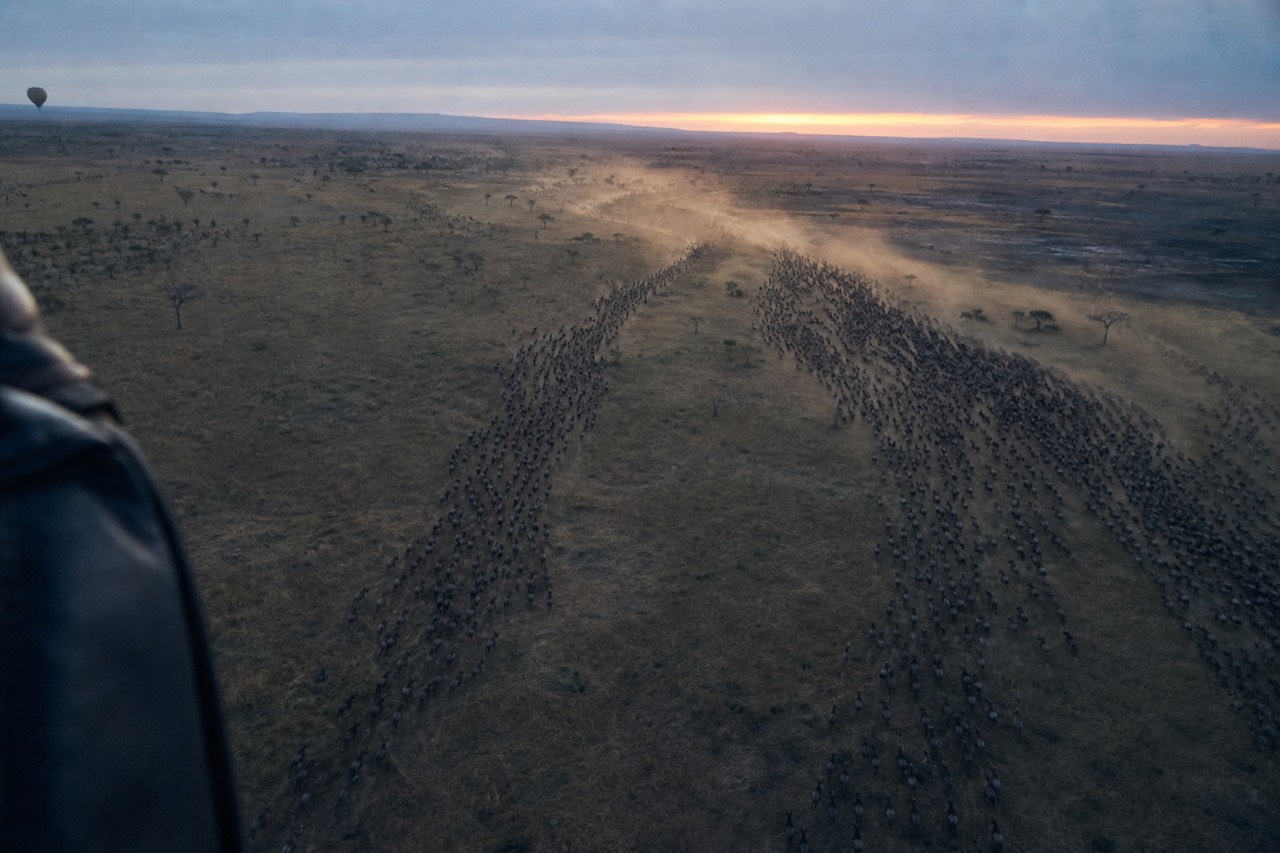
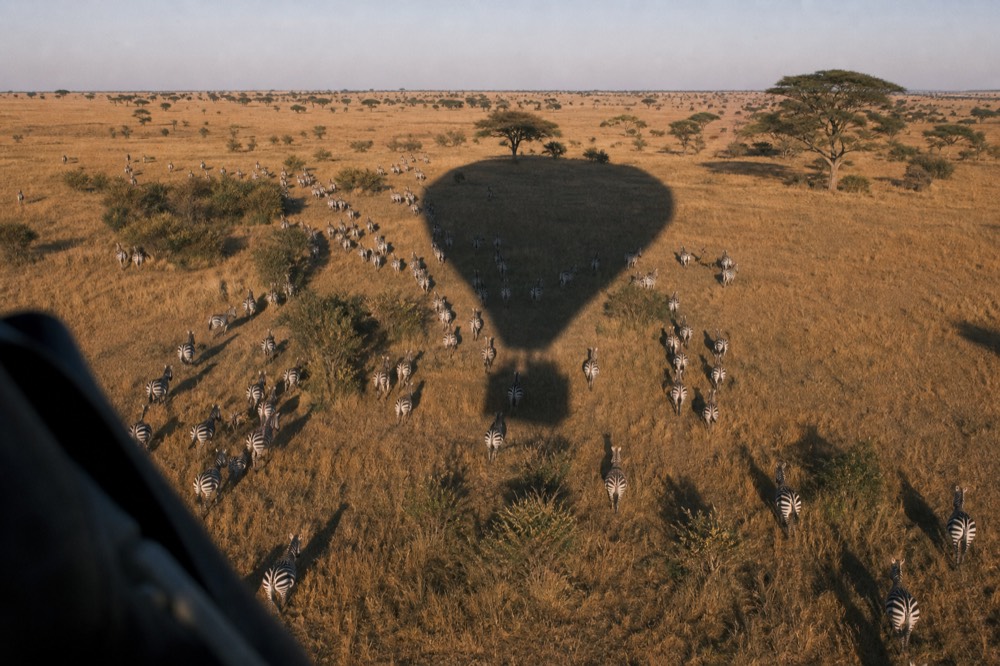
There is a sound the herds make that carries a surprising distance in still morning air, and from a basket a few hundred feet up it arrives before the animals resolve into individuals. What you see first is texture: a dark grain across the grass, moving in one direction, with pale gaps where the ground shows through. Only when the pilot drops a hundred feet does the grain become fifty thousand animals walking.
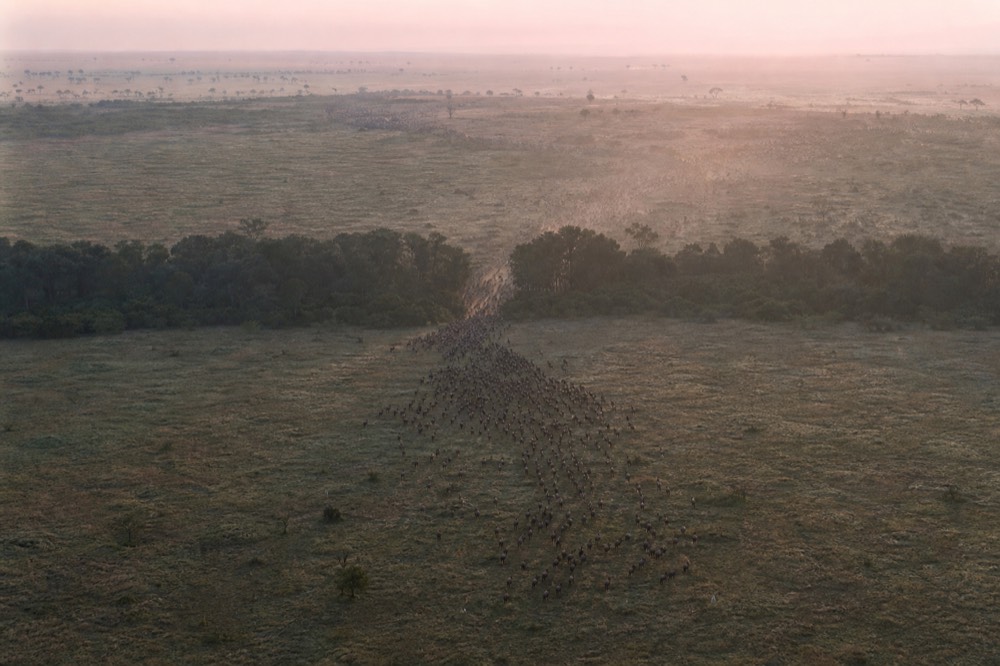
That is the version of the migration that a balloon is good at. Not the crossing, which is a lottery, but the shape of the thing: the columns, the worn lanes, the way the mass bends around a stand of trees. A vehicle puts you inside it at eye level. A balloon puts you above it, where the pattern is legible.
Choose a launch region near your camp; no balloon itinerary can promise the herds or a river crossing.
Booking choice: explore SBS’s regional flights for the aerial perspective alongside your game drives. Explore the itinerary & inclusions
Can you actually see the Great Migration from a balloon?
Often, yes, but only when your month and your launch field line up. Three of the four fields sit under the migration for part of the year: Ndutu from 20 December to 31 March, the Western Corridor June to October, Kogatende July to October. Nothing is guaranteed, because a balloon drifts on the dawn wind and cannot be steered toward a herd.
The honest framing is a probability, not a promise, and it is set before you ever climb into the basket. If you launch at Kogatende in mid-August you are lifting off in the sector where the wildebeest are, and the odds of an enormous herd underneath you inside seventy minutes are high. Launch from Seronera in April and the migration is not the point of the flight at all.
What confuses people is the difference between seeing the migration and seeing a crossing. The migration is a two-million-animal population moving through a landscape over months. A crossing is a specific event at a specific bend of the Mara River that might last twenty minutes and might start at eleven in the morning. Balloons fly at dawn for seventy minutes. The maths on catching a crossing from the air is not in your favour, and any operator who suggests otherwise is overselling.
The maths on seeing the herds themselves is a different story. From altitude in the northern sector during crossing season, the animals are not a sighting, they are the landscape. That is the realistic expectation to book against, and it is a big one.
Where the herds sit each month, and which field flies there
The herds run a rough annual loop: calving on the southern plains January to March, central Serengeti April and May, the Western Corridor in June, the north and the Mara River July to October, then south again through November and December. Three launch fields intersect that loop, one for each phase.
The loop is driven by rainfall and grazing rather than by a calendar, which is why the same month can look different from one year to the next. What does not change is the sequence. The herds always go south for the short rains, always calve on the short-grass plains, always work north through the middle of the year. Only the timing slides. The launch fields, by contrast, run to fixed dates: the operator's published field schedule shows the same windows for 2026-2027 as the season before.
| Month | Where the herds usually are | Nearest launch field | Field operating? | What is under the drift |
|---|---|---|---|---|
| January | Southern plains, calving beginning | Ndutu | Yes, from 20 December | Massed herds on short green grass |
| February | Southern plains, calving at density | Ndutu | Yes | Calves, predators working the edges |
| March | Ndutu until mid-month, then drifting | Ndutu to 31 March | Until 31 March | Herds starting to string out north-west |
| April | Central Serengeti, spread wide | Seronera | Yes, year-round | Resident game, kopjes, tall green grass |
| May | Central, columns forming westward | Seronera | Yes | Long marching lines on the move |
| June | Western Corridor and the Grumeti | Kirawira / Grumeti | Yes, from June | Herds funnelling along the river system |
| July | Pushing north, first crossings logged | Kogatende | Yes, from July | Northern grassland filling with animals |
| August | Northern Serengeti and Mara River | Kogatende | Yes | Peak density, columns and dust |
| September | North, crossings continuing | Kogatende | Yes | Herds working both sides of the river |
| October | North, beginning to turn south | Kogatende | Yes, to October | Thinning columns, herds heading back |
| November | Moving south through east and centre | Seronera | Yes | Scattered movement, greening plains |
| December | Southern plains by late month | Ndutu from 20 December | From 20 December | Herds settling for calving |
Two things fall out of that table. The northern sector has a four-month window and a single field, which is why July to October is the tightest booking stretch of the year. And April and May have no migration-aligned field at all, which is not a problem so much as a different flight: the central Serengeti's resident population does not go anywhere. The month-by-month flying calendar weighs those trade-offs against weather and booking pressure.
What a river crossing looks like from altitude
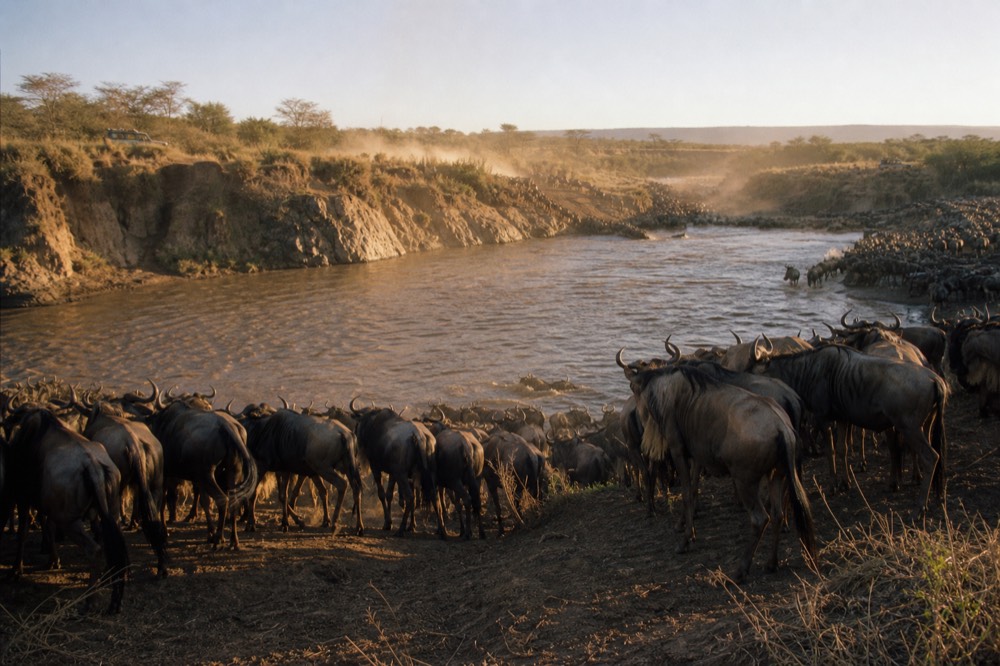
From a vehicle you get one bank, one crossing point and the noise. From a balloon you get the geometry: the funnel of animals feeding toward the water, the column stretching back kilometres, and the river as a hard dark line with worn scars where the banks have been broken down by hooves.
Height changes what the eye can resolve. At ground level a crossing is overwhelming and almost impossible to read, because you are inside it and the dust sits at your eye height. A few hundred feet up, the dust is below you and the whole structure appears: where the herd is coming from, where it is bottlenecking, which of the four possible entry points it has picked.
The trade is detail. You are not going to see a calf lose its footing or a crocodile move, and you are not going to hear much over the burner. What you get instead is scale, which is the one thing a vehicle can never give you, because from the ground the herd always ends at the nearest ridge.
There is a timing reality underneath all of this. Crossings happen when the herds decide to cross, which is frequently mid-morning or later, and balloons are back on the ground with breakfast in front of them by then. The realistic aerial prize is the massed herds themselves and the approach columns, not the moment of the leap.
| What you are trying to see | From a vehicle at the bank | From a basket at altitude |
|---|---|---|
| The moment animals enter the water | Excellent, if you picked the right point | Unlikely; crossings often start after landing |
| Scale of the herd | Ends at the nearest ridge | The full column, kilometres of it |
| Structure and direction of movement | Hard to read from inside it | Obvious; lanes and funnels are visible |
| Predator positioning | Only what is in your sightline | Whole edges of the herd at once |
| Sound and dust | Full immersion | Muted; burner noise and clean air above the dust |
| Choosing where to be | You can drive to a crossing point | None; the wind sets the track |
| Time of day covered | Any hour you are willing to wait | Roughly 50 to 70 minutes at dawn |
The sensible conclusion is that these are complementary rather than competing. Trips that do both, a balloon morning and vehicle time at the river on other days, get the scale and the event. Trips that pick one should pick based on what they came for. Our hour-by-hour account of the flight morning covers what the balloon half of that actually involves.
The August peak, and what the 2026 season logged
August is the most active crossing month across the long-term record, and 2026 held to it. Trackers logged Mara River crossings on 15, 20 and 21 August, with 20 August described as thousands of animals coming down steep banks in a continuous fall. Crossing activity had been building since mid-July at points near Kogatende.
The 2026 season is useful precisely because it was unremarkable. No early surge, no late collapse, nothing that would have wrecked a trip planned twelve months out on the standard pattern. Herds moved north through April to June, crossings built through July, and August delivered the density that the long-term record predicts.
| Date logged | Reported location | What observers recorded |
|---|---|---|
| 16 July 2026 | Mara Triangle | Herds crossing into the Triangle |
| 17 July 2026 | Crossing Point 6, near Kogatende | Crossing activity at the point |
| 26 July 2026 | Crossing Point 0 | Crossing logged |
| 28 July 2026 | U Circuit | Crossing filmed |
| 5 August 2026 | Crossing Point 6 | Herd moving south to north |
| 15 August 2026 | Northern Serengeti | River crossing as herds continued north |
| 20 August 2026 | Mara River | Thousands crossed, a wall of animals down steep banks |
| 21 August 2026 | Mara River | First animal took the leap, then a full-scale crossing |
Those points have names because guides and camps use them as reference markers, and the numbered crossing points along the river are stable features rather than one-off spots. The Serengeti's whole listing as a World Heritage site rests partly on this movement, which is a reminder that what you are flying over is a protected phenomenon rather than a show that gets arranged for visitors. The rest of what built that reputation, from the herd arithmetic to the name the Maasai gave the plains, sits in why the Serengeti is world famous.
How much does the timing move from year to year?
Four to eight weeks in either direction, driven by rainfall. Rain pulls the herds toward fresh grazing, so a wet March holds them south longer and a dry one pushes them north early. The sequence never changes, only the dates, which is why booking to the pattern still works if you leave yourself margin.
That variance is the reason nobody sensible sells a guaranteed crossing date. It is also the reason the middle of a season is safer than its edges. A trip in the first week of July or the last week of October is betting on the herds being at the extreme of their normal range. A trip in mid-August is betting on them being where they usually are, which in 2026 they were.
| What moves the timing | Effect on the herds | What it means for your booking |
|---|---|---|
| Heavy late long rains | Grazing holds in the south and centre longer | Northern arrival slides later, edges of July get risky |
| Early dry-out | Herds push north sooner | Early July can be better than expected |
| Localised storms in the north | Herds mill rather than cross | Crossings cluster into bursts, not a steady stream |
| Rainfall on the Kenyan side | Draws herds across and holds them there | Fewer animals on the Tanzanian bank that week |
| Normal rainfall year | The pattern runs to type, as 2026 did | Mid-August is the highest-probability window |
You can watch the season develop rather than guessing at it. The live migration tracker collects dated sightings from guides and camps across the ecosystem, which is the closest thing to a public real-time herd position. Check it in the two or three months before you travel and you will know whether the season is running early or late before you finalise which camps you sleep in. If that shuffle lands you on the Ngorongoro Conservation Area side of the ecosystem, the flight with the widest published pickup reach is the one that will still send a vehicle, at $599 with park entry billed separately.
Why a balloon cannot chase the herds
A balloon has exactly one control: altitude. The pilot climbs or descends to find a wind layer moving in a different direction, and that is the whole of the steering. There is no throttle, no rudder and no way to fly toward a herd that is sitting off to one side. The wind decides the track.
This is not a limitation the industry hides, but it does get lost in the marketing imagery. Understanding it changes how you plan. Since the pilot cannot chase anything, the only lever you control is where the launch field is, which is why the field and month selection matters so much more than the flight brand.
In practice a pilot reads the layers before launch, picks a launch point that puts the likely track over interesting ground, and then works altitude through the flight to nudge the drift. Skilled flying makes a real difference to what passes underneath. It does not amount to navigation in the way a helicopter would.
| Element of the flight | Who or what controls it | Can it be requested? |
|---|---|---|
| Direction of travel | The wind, at whatever layer you are in | No |
| Altitude | The pilot, via burner and vent | Loosely, conditions permitting |
| Launch point | The operator, fixed field per season | No, it comes with your booking |
| Time of launch | First light, every operator | No, dawn only |
| Time airborne | 50 to 70 minutes | No |
| Landing spot | Wherever the drift ends up | No |
| Whether the flight goes at all | The pilot, on the morning's weather | No, and that is the point |
Two consequences worth planning around. First, a scrubbed morning is the system working, not failing: the operator rebooks you or refunds in full, and every listing cancels free up to 24 hours out. Second, since you cannot steer, giving the flight the best possible starting position is the only optimisation available, which is exactly what matching your camp to the right launch field is for. On a central-circuit route that starting position is Seronera, and the Seronera-area listing with the longer sit-down breakfast is the tidiest fit for it at $599 before park fees.
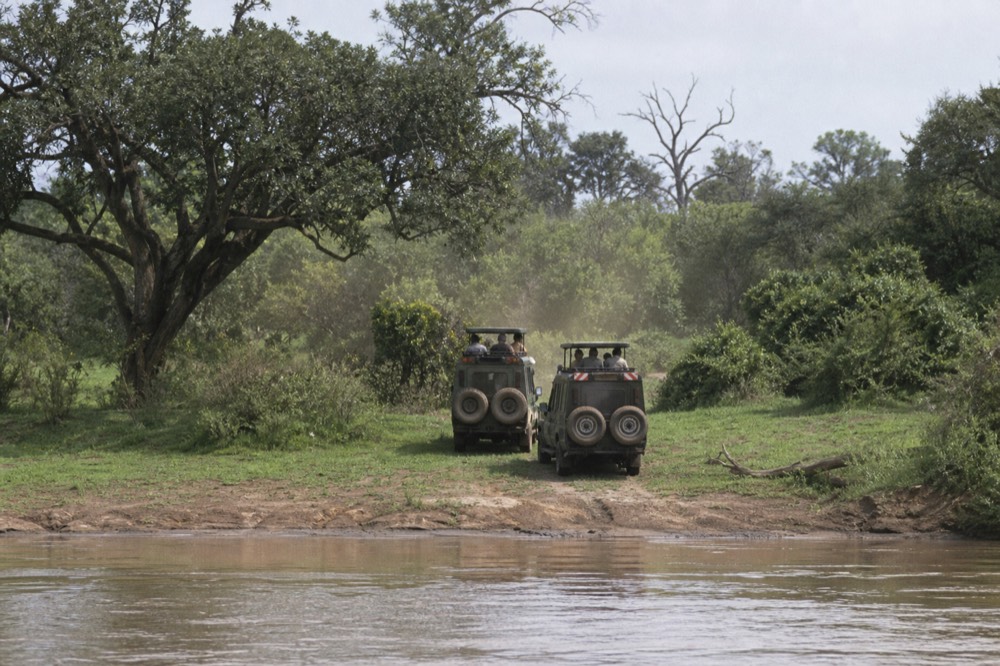
Calving in the south or crossings in the north?
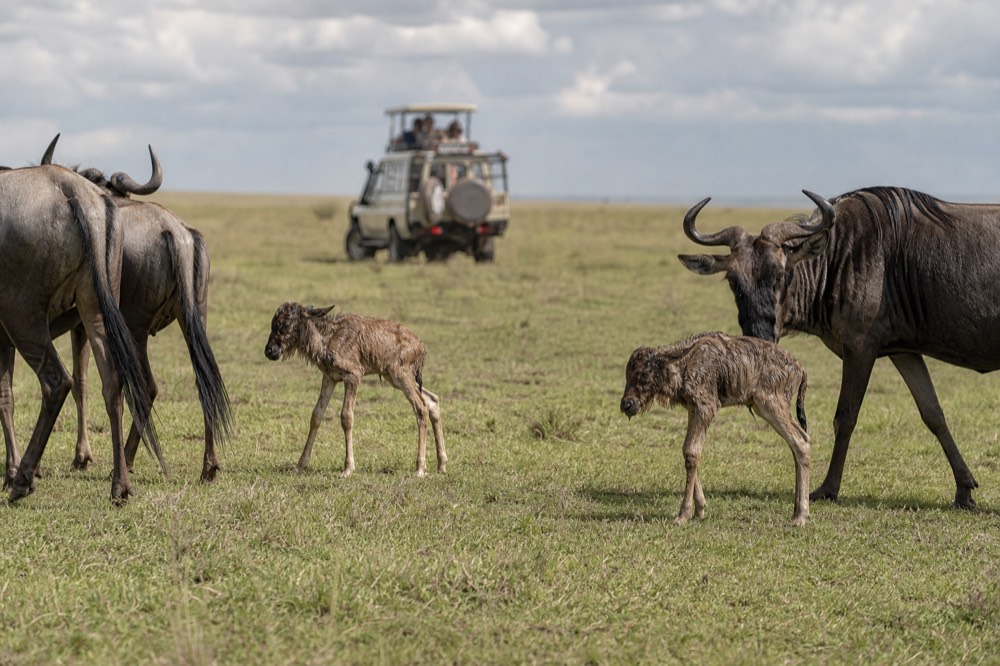
Calving is density; crossings are drama. The Ndutu field flies over hundreds of thousands of animals packed onto short green plains from 20 December to 31 March, with predators on every edge. Kogatende flies over the northern river country July to October, where the herds are strung out and the crossings happen.
For photography from a balloon, calving season often has the edge. The animals are concentrated in one place rather than distributed over a huge area, the grass is short, and the light in the green season has a different quality after overnight rain has washed the dust out of the air. Fewer visitors are in the park too.
The north has the reputation, and it earns it for the events themselves. But from a basket the north is also where you are most likely to drift over ground the herds have already left, because the population is spread across a much wider sector at that time of year. That is a real trade-off and it rarely gets stated.
| Dimension | Ndutu, 20 Dec to 31 Mar | Kogatende, Jul to Oct |
|---|---|---|
| Herd distribution | Concentrated on short-grass plains | Spread across a wide northern sector |
| The headline event | Calving and predator activity | Mara River crossings |
| Grass height | Short, grazed and green | Short, dry and bleached |
| Odds of herds under your drift | High, the concentration is small | Good, but the sector is large |
| Visitor pressure | Lower, outside festive weeks | Peak season |
| Field window length | About eleven weeks | About four months |
| Weather risk to the flight | Higher, green season systems | Lowest of the year |
If your dates are flexible and the goal is animals underneath the basket rather than a crossing on video, the February case is stronger than its reputation. If the crossing is the whole point, the north in August is the answer and the park-wide month comparison helps you frame the rest of the trip around it.
Which flight makes sense for a migration trip?
All four fly the same envelope of product: dawn launch, shared basket, 50 to 70 minutes airborne, cooked bush breakfast and a certificate on the ground, about five hours door to door. For a migration trip the deciding factor is which one collects from the camp your herd sector requires.
The two classic flights carry the review weight, at 4.9 across 3,504 and 5.0 across 2,651 respectively, both from $599 per person with Serengeti park entry billed separately through your safari. One collects from camps within roughly two hours or 40 km of the launch fields on both the Serengeti and Conservation Area sides; the other collects from inside the national park, starts with tea or coffee at the field and finishes with a plated bush breakfast.
The boutique pair is narrower on proof and different on logistics: a Seronera-area pickup with a longer sit-down breakfast at $599, and a wider accommodation list with a champagne breakfast at $643. Neither price includes park entry. If your migration plan puts you in the north in August or at Ndutu in February, work backwards from your camp's pickup list rather than from the listing you like best. Related reading: the full flight lineup.
Frequently asked questions
Can you see the Great Migration from a hot air balloon?
Yes, when your month and launch field line up. Ndutu flies over calving herds 20 December to 31 March, the Western Corridor field June to October, and Kogatende over northern river country July to October. A balloon drifts with the dawn wind and cannot be steered toward a herd, so treat it as high odds rather than a guarantee.
What month is the Mara River crossing?
Crossings typically run July to October, building through July and peaking in August and September. August is the most active month in the long-term record. In 2026 crossings were logged on 15, 20 and 21 August, with earlier activity at points near Kogatende from mid-July. Timing shifts 4 to 8 weeks year to year with rainfall.
Will I see an actual river crossing from the balloon?
Probably not, and no operator should promise it. Balloons fly at dawn for 50 to 70 minutes, while crossings frequently start mid-morning or later. What you can realistically expect in the northern sector during crossing season is the massed herds themselves and the approach columns, which is a far bigger sight than most people anticipate.
Can the pilot fly toward the herds?
No. A balloon's only control is altitude, used to find a wind layer moving in a different direction. There is no throttle and no rudder. The pilot picks the launch point and works the layers, which meaningfully shapes the track, but the wind decides where you actually go. Choosing the right launch field is the real lever.
Is calving season better than crossing season from the air?
For sheer density under the basket, often yes. Between 20 December and 31 March the Ndutu field flies over herds concentrated on short-grass plains with predators working the edges, in a quieter park. Crossing season in the north has the famous events but spreads the animals across a much wider sector.
How much does a migration balloon flight cost?
The standard rate is $599 per person across the three classic dawn listings, with a champagne variant at $643. Prices match the operators' own published rates. Serengeti park entry is not included in any of them: it runs roughly $70 per non-East-African adult per day under the latest published tariff and is billed with your safari.
Choose the experience that fits your trip
General starting point; dates, pickup and passenger acceptance still need confirmation.
Match your camp and month · alternatives & optional controls
- Miracle Experience: balloon safari & bush breakfast — About five hours with camp transfers, tea/coffee, flight, breakfast and binoculars. Park entry and outside-park transfers excluded. Listing excludes under 120 cm and over 120 kg; child booking bands start at 5, but acceptance requires operator confirmation. No pregnancy or significant back/heart conditions.
- Nyssa: Seronera flight & luxury bush breakfast — Five-hour central Serengeti morning with camp pickup, breakfast and washrooms at launch and breakfast. Finishes at Serengeti Visitor’s Centre. Park entry and outside-park transfers excluded. No pregnancy, back problems, recent surgery or wheelchair use. Confirm child eligibility directly.
Serengeti Balloon Safaris: dawn flight & breakfast
Have your travel dates? Check the itinerary and final price before fixing the rest of your trip.
About five hours including transfers, sunrise flight and bush breakfast. Park entry is extra. Ages 7+. Camp pickup and weight acceptance must be confirmed; no pregnancy, significant back or heart conditions.
Check dates & final price on Viator